
Cuba’s new challenges: Inequality, emigration
As she made her way through the busy streets of Havana earlier this year, Ruth Behar stopped to check out some of the new boutiques, cafes, salsa dancing studios and a gelato store. (more…)
As she made her way through the busy streets of Havana earlier this year, Ruth Behar stopped to check out some of the new boutiques, cafes, salsa dancing studios and a gelato store. (more…)
AUSTIN, Texas — Scientists working on islands in Florida have documented the rapid evolution of a native lizard species — in as little as 15 years — as a result of pressure from an invading lizard species, introduced from Cuba.
After contact with the invasive species, the native lizards began perching higher in trees, and, generation after generation, their feet evolved to become better at gripping the thinner, smoother branches found higher up. (more…)
Yale geology and geophysics professor Ruth Blake recently completed a tour of duty as lead scientist aboard the exploration vessel Nautilus, during the Windward Passage leg of the ship’s 2014 exploration season.
The Windward Passage is the body of water between Cuba and Haiti, where the Atlantic Ocean flows into and exchanges water with the Caribbean Sea. Blake’s stint as lead scientist lasted Aug. 18–28.
Blake spoke with YaleNews about the scientific mission at the heart of the journey. (more…)
History has long denied the political genius of the Black Panther Party. At worst, its members have been cast as unconscionable criminals. At best, such seminal figures as party founders Huey Newton and Bobby Seale and early supporter Stokely Carmichael have been portrayed as outlaw folk heroes who, propelled by the progressive winds of the late 1960s, dared to take on the establishment.
But a UCLA graduate student in sociology who worked alongside former Panthers a decade ago as a community organizer in Oakland, Calif., didn’t buy the conventional wisdom. (more…)
October marks the 50th anniversary of of the 13-day Cuban Missile Crisis, when President John F. Kennedy discovered that the Soviet Union was building secret missile bases in Cuba. Forgoing the option of a Cuban invasion or air strikes, Kennedy asked Russian Premier Nikita S. Khrushchev to remove all weapons from the island, and on Oct. 28, 1962, Khrushchev conceded, halting the standoff. Here, Khrushchev’s son, Sergei Khrushchev, visiting professor of Slavic languages at Brown, reflects on the diplomatic lessons.
The perspective of the crisis has changed over time and today the history of the crisis is more focused not on the confrontation, but on cooperation.
The Cuban Missile Crisis showed that two leaders decided not to shoot first, but to think and negotiate with each other. And today that is very unusual, because we think we can only negotiate with friends. Today, we impose unconditional surrender and nobody surrenders unconditionally until fully defeated. (more…)
GAINESVILLE, Fla. — As a carrier of as many as 100 types of germs, the common house fly is hardly as innocuous as its name might suggest.
Military personnel know this firsthand, and their need for effective fly control has helped University of Florida researchers create an innovative new fly control device. (more…)
GAINESVILLE, Fla. — Florida has the world’s worst invasive amphibian and reptile problem, and a new 20-year study led by a University of Florida researcher verifies the pet trade as the No. 1 cause of the species’ introductions.
From 1863 through 2010, 137 non-native amphibian and reptile species were introduced to Florida, with about 25 percent of those traced to one animal importer. The findings appear online today in Zootaxa. (more…)
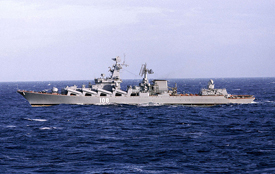
Russian guided missile cruiser SLAVA. Source: Wikipedia
Russia may open new naval bases in other countries, President Dmitry Medvedev stated November 25 at a meeting with Russia’s top brass.
“Unfortunately, the reality is that a number of our previous opportunities have disappeared,” Medvedev said. Medvedev said that he now had “certain ideas” about how these could be replaced. “But for obvious reasons, I will not say them out loud,” he added.
First and foremost, it goes about support points for Russian vessels on the territory of foreign countries. It is necessary to build such objects to support Russia’s military presence in strategically important parts of the globe. (more…)