
Tag Archives: fertilization

Pistil leads pollen in life-and-death dance

Pollination, essential to much of life on earth, requires the explosive death of the male pollen tube in the female ovule. In new research, Brown University scientists describe the genetic and regulatory factors that compel the male’s role in the process. Finding a way to tweak that performance could expand crop cross-breeding possibilities.

PROVIDENCE, R.I. [Brown University] — Millions of times on a spring day there is a dramatic biomolecular tango where the flower, rather than adorning a dancer’s teeth, is the performer. In this dance, the female pistil leads, the male pollen tubes follow, and at the finish, the tubes explode and die. A new paper in Current Biology describes the genetically prescribed dance steps of the pollen tube and how their expression destines the tube for self-sacrifice, allowing flowering plants to reproduce. (more…)
Read More

UCLA researchers discover sperm move along a ‘twisting ribbon’

Opening the door to more sophisticated investigation of sperm locomotion and biophysics, researchers from UCLA’s Henry Samueli School of Engineering and Applied Science have identified previously unobserved swimming patterns in human and horse sperm cells.

This research, published in Scientific Reports, a journal of the Nature Publishing Group, could lead to a deeper understanding of how sperm move on their way to fertilization or other functions and how they react when encountering various toxins or chemicals. (more…)

Read More

Pollination with Precision: How Flowers Do It

Pollination could be a chaotic disaster. With hundreds of pollen grains growing long tubes to ovules to deliver their sperm to female gametes, how can a flower ensure that exactly two fertile sperm reach every ovule? In a new study, Brown University biologists report the discovery of how plants optimize the distribution of pollen for successful reproduction.

PROVIDENCE, R.I. [Brown University] — Next Mother’s Day, say it with an evolved model of logistical efficiency — a flower. A new discovery about how nature’s icons of romance manage the distribution of sperm among female gametes with industrial precision helps explain why the delicate beauties have reproduced prolifically enough to dominate the earth.

In pollination, hundreds of sperm-carrying pollen grains stick to the stigma suspended in the middle of a flower and quickly grow a tube down a long shaft called a style toward clusters of ovules, which hold two female sex cells. This could be a chaotic frenzy, but for the plant to succeed, exactly two fertile sperm should reach the two cells in each ovule — no more, no less. No ovule should be left out, either because too many tubes have gone elsewhere, or because the delivered sperm don’t work. (more…)

Read More

Counting Horseshoe Crabs

Marine science majors conduct field research with horseshoe crab census

Wearing sneakers and rain boots, University of Delaware freshmen got their feet wet as marine biologists recently while counting horseshoe crabs along the Delaware Bay. The students participated in a monitoring effort to gain firsthand experience in field research with their fellow marine science majors.

“Where else can you go on a Saturday night to count horseshoe crabs?” freshman Will Goldman said. (more…)

Read More

A Bug’s (Sex) Life: Diving Beetles Offer Clues About Sexual Selection

*Studies of diving beetles suggest sperm evolution may be driven by changes in female reproductive organs, challenging the paradigm of post-mating sexual selection being driven mostly by competition among sperm.*

Studying female reproductive tracts and sperm in diving beetles (Dytiscidae), researchers from the University of Arizona and Syracuse University have obtained a glimpse into a bizarre and amazing world of sperm that can take on a variety of forms – including joining together into conglomerates that navigate the twisted mazes of the female reproductive tract.

Analyses of the evolutionary relationships among diving beetles reveal that sperm form appears to follow function dictated by female reproductive organs. (more…)

Read More

The Genetics of Self-Incompatibility

*Petunias show that the mechanisms behind inbreeding prevention are similar to immune response*

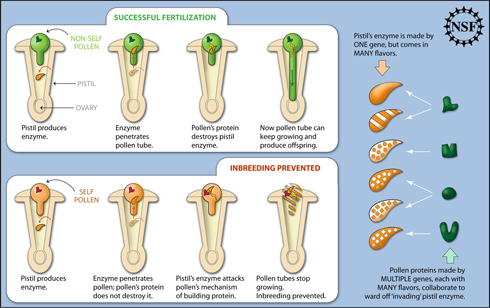
About the image: The female part of the petunia flower secretes an enzyme that is designed to deter pollen tube growth, thereby preventing fertilization. However, in the cases that the pollen has come from a genetically different plant, the pollen produces its own protein that combats the pistil’s enzyme. With the enzyme out of the way, the pollen tube can keep growing and fertilization can occur. Image credit: Zina Deretsky, National Science Foundation

Inbreeding is a bad strategy for any organism, producing weak and problematic offspring. So imagine the challenge of inbreeding prevention in a plant where male and female sexual organs grow right next to each other! Such is the genetic conundrum faced by the petunia. (more…)

Read More