College Park, Md. – While the U.S. jobs picture may be bleak, the proliferation of Facebook and mobile technology applications has spawned an entirely new industry dubbed the “App Economy” – that has added at least 182,000 new jobs and contributed more than $12.19 billion in wages and benefits to the U.S. economy this year, according to new research from the University of Maryland’s Robert H. Smith School of Business. Using more aggressive estimates, the Facebook App Economy created a total of 235,644 jobs, adding a value of $15.71 billion to the economy. (more…)
Have you been unemployed lately? If so, then you probably know how frustrating it is to try to find a job in the United States today. It now takes the average unemployed worker about 33 weeks to find a job. There are millions of Americans that have not been able to find a full-time job even after searching hard for an entire year. Some areas of the United States have been devastated so badly by the economic downturn that they are starting to resemble war zones.
Unless you have been there, it is hard to even try to describe the extreme frustration that one feels when you are unable to pay the mortgage and feed your family. It can be absolutely soul-crushing. But it is not the fault of those who are unemployed. The truth is that our economy is dying and it is not producing nearly enough jobs anymore. Unfortunately, as you will see from the facts listed below, most of the things that are causing our economy to die have no realistic chance of being changed any time soon.
The following are 10 reasons why it has become so insanely difficult to find a job in America today…. (more…)
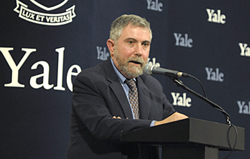
Nobel Prize-winning economist and New York Times columnist Paul Krugman had some generally dismal news for the near capacity audience that came to Sprague Hall on Tuesday for his Jackson Institute-sponsored town hall meeting.
The gathering, aimed at undergraduates, was held in conjunction with Krugman’s visit to Yale to receive the Henry E. Howland Memorial Prize, one of the highest honors that the University bestows.
Krugman was introduced by President Richard C. Levin; the two were briefly colleagues in Yale’s Department of Economics in the 1970s. He kicked off the Q&A with background on the current economic situation. (more…)
COLUMBIA, Mo. – As the U.S. economy continues to lag, many investors remain wary about taking risks with the stock market. Now, researchers at MU have concluded that this attitude toward investment risk-taking is more than just a recent trend.
On August 15, South Korean President Lee Myung-bak delivered a plan for unification of his country with the Democratic People’s Republic of Korea (DPRK). The proposal was made during the ceremony marking the 65th anniversary of the liberation of the Korean peninsula from the Japanese colonial rule.
For several years, the World Bank has been announcing its plans to find solutions to solve the world food crisis, whereby vast swathes of the world’s population find it increasingly difficult to put food on the family table, while the banks bail each other out and fat cat bankers get fatter. The morality of the issue is staggeringly incomprehensible.
The victory of the Spaniards over the Dutch in the World Cup will help the economy, experts say.
The euphoria of the victory improves the mood of the population, and the population in a good mood begins to spend more money and shop more frequently.