*The United States Department of Agriculture (USDA) is moving its e-mail, document sharing, and other collaboration tools to Microsoft’s cloud infrastructure to save money and improve efficiency.*
REDMOND, Wash. — Dec. 8, 2010 — The United States Department of Agriculture (USDA) announced today that it is moving its on-premises e-mail and productivity applications to Microsoft’s cloud infrastructure, becoming the first cabinet-level federal agency to embrace the cloud.
In one of the largest cloud federal government deployments ever, the USDA is moving its 120,000 users to Microsoft Online Services, consolidating 21 different messaging and collaboration systems into one, said Chris Smith, the USDA’s chief information officer. The USDA plans to start the shift within the next four weeks.(more…)
Most Americans receive health insurance coverage through their employer, or through an employed family member’s dependent coverage. Yet having a job is no guarantee of coverage, according to a new policy brief from the UCLA Center for Health Policy Research.
Using data from the California Health Interview Survey (CHIS), the brief’s authors found that one-fifth of Californians under age 65 who lived in households with at least one employed family member — or 5.7 million – had no access to job-based health insurance in 2007.(more…)
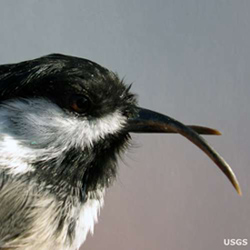
This Black-capped Chickadee, captured in Anchorage, Alaska, demonstrates an overgrown beak characteristic of avian keratin disorder. Beak deformities in this species were first observed in the late 1990s and biologists have since documented more than 2,100 affected individuals in Alaska. Image credit: U.S. Geological Survey
ANCHORAGE, Alaska – The highest rate of beak abnormalities ever recorded in wild bird populations is being seen in a number of species in the Northwest and Alaska, and scientists to this point have not been able to isolate the cause.
Black-capped Chickadees, Northwestern Crows, and other birds are being impacted by the problem, which affects their ability to feed and clean themselves and could signal a growing environmental health problem.
In birds affected by what scientists have termed “avian keratin disorder,” the keratin layer of the beak becomes overgrown, resulting in noticeably elongated and often crossed beaks, sometimes accompanied by abnormal skin, legs, feet, claws and feathers. Biologists with the U.S. Geological Survey’s Alaska Science Center published their findings in this month’s issue of The Auk, a Quarterly Journal of Ornithology.
“The prevalence of these strange deformities is more than ten times what is normally expected in a wild bird population,” said research biologist Colleen Handel with the USGS, “We have seen effects not only on the birds’ survival rates, but also on their ability to reproduce and raise young. We are particularly concerned because we have not yet been able to determine the cause, despite testing for the most likely culprits.” (more…)
The fault initially thought to have triggered January’s devastating earthquake in Haiti is likely still under considerable strain and continues to pose a significant seismic hazard, according to a study published online in Nature Geoscience Sunday.
U.S. Geological Survey geologist Carol Prentice led a team of scientists to Haiti immediately after the earthquake to search for traces of ground rupture and to investigate the geology and paleoseismology of the area. (more…)
Washington, D.C. – As part of a broad effort to achieve breakthrough innovations in energy production, U.S. Deputy Secretary of Energy Daniel Poneman announced, on July 22, an award of up to $122 million over five years to a multidisciplinary team of top scientists to establish an Energy Innovation Hub aimed at developing revolutionary methods to generate fuels directly from sunlight.
*Dramatic imagery from NASA Mars missions creates new user experiences in the Microsoft Research WorldWide Telescope.*
REDMOND, Wash. — Microsoft Research and NASA are providing an entirely new experience to users of the WorldWide Telescope, which will allow visitors to interact with and explore our solar system like never before.