UA researchers are using aviation’s high standards in an effort to increase our confidence in the safety of robotic cars.
Passengers climbing into self-driving cars — also known as highly automated vehicles, or HAVs — need to believe that their vehicles can avoid potential hazards. So Mathieu Joerger, a University of Arizona assistant professor of aerospace and mechanical engineering, and researchers at the Illinois Institute of Technology are building on a knowledge of aircraft navigation standards to improve and guarantee HAV safety.(more…)
South Korea’s most powerful data storage system helps tackle weather’s data deluge
Seoul, SOUTH KOREA – 27 Feb 2013: South Korea’s Meteorological Administration (KMA) and IBM today announced a project to help KMA and its affiliate, the National Meteorological Satellite Center (NMSC), tackle Big Data for better, more accurate and predictive environmental forecasting.
As South Korea’s national meteorological organization, KMA’s mission is to protect citizens’ lives and property from natural disasters and support economic activities sensitive to environmental conditions. (more…)
COLUMBUS, Ohio – A South American butterfly flapped its wings, and caused a flurry of nanotechnology research to happen in Ohio.
Researchers here have taken a new look at butterfly wings and rice leaves, and learned things about their microscopic texture that could improve a variety of products.
For example, the researchers were able to clean up to 85 percent of dust off a coated plastic surface that mimicked the texture of a butterfly wing, compared to only 70 percent off a flat surface. (more…)
Russia was ready to sign a contract with China to supply 48 multi-role Su-35 fighter jets. However, Russia put forward a condition to the Celestial Empire. Moscow demands guarantees that the aircraft will not be further copied for sale.
According to Kommersant, the amount of the expected transaction could reach $4 billion, or approximately $85 million per unit. If the contract is signed, it will be the largest arms contract of the last decade.(more…)
A novel project using cameras mounted on unmanned aircraft flying over the Arctic is serving double duty by assessing the characteristics of declining sea ice and using the same aerial photos to pinpoint seals that have hauled up on ice floes.
The project is the first to use aircraft to monitor ice and seals in remote areas without putting pilots and observers at risk, said Elizabeth Weatherhead of the University of Colorado at Boulder, who is leading the study team. Weatherhead is a senior scientist at the Cooperative Institute for Research in Environmental Sciences, a joint venture of CU-Boulder and the National Oceanic and Atmospheric Administration. (more…)
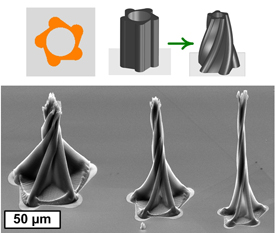
Twisting spires are one of the 3D shapes researchers at the University of Michigan were able to develop using a new manufacturing process. Image credit: A. John Hart
ANN ARBOR, Mich
.— Twisting spires, concentric rings, and gracefully bending petals are a few of the new three-dimensional shapes that University of Michigan engineers can make from carbon nanotubes using a new manufacturing process.
The process is called “capillary forming,” and it takes advantage of capillary action, the phenomenon at work when liquids seem to defy gravity and spontaneously travel up a drinking straw.
The new miniature shapes have the potential to harness the exceptional mechanical, thermal, electrical, and chemical properties of carbon nanotubes in a scalable fashion, said A. John Hart, an assistant professor in the Department of Mechanical Engineering and in the School of Art & Design.
The 3D nanotube structures could enable countless new materials and microdevices, including probes that can interface with individual cells, novel microfluidic devices, and lightweight materials for aircraft and spacecraft. (more…)
Technologies for using laser energy to destroy threats at a distance have been in development for many years. Today, these technologies — known as directed energy weapons — are maturing to the point of becoming deployable.