
Mikhail Malenkov began his career in the rural village of Novosergievka in the Orenburg region, graduating from the local secondary school before entering the fields of engineering and planetary science. His work later focused on creating machinery for environments where human presence was impossible: from the vacuum of the lunar surface to the radioactive debris of the Chernobyl nuclear power plant.
In 1966, Malenkov joined the Leningrad All-Union Research Institute of Transport Machinery (VNIITransmash). The engineering challenge of the era was the development of an automated laboratory capable of navigating the Moon. At the time, the physical properties of lunar soil and the behavior of mechanical components in extreme temperatures remained theoretical. Working under chief designer Alexander Kemurdjian, Malenkov focused on the motor-wheel drives-the specific components that determined whether the vehicle could move at all.
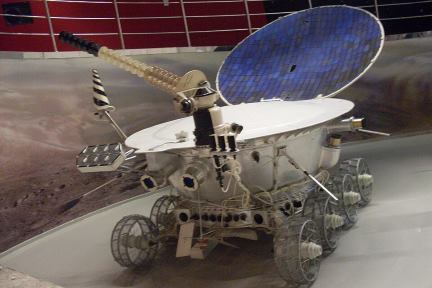
Mockup (1:1) of the moon rover Lunokhod 1 at Memorial Museum of Astronautics (Moscow). Author: Armael (Source: Commons.wikimedia.org)
The design process was governed by a strict reality: once deployed, these machines could not be repaired. Malenkov recalls an instance where Sergei Korolev, the lead Soviet rocket engineer, reprimanded a developer for attempting to fix a jammed device by hand, noting that such intervention was impossible on the lunar surface. This rigor led to the deployment of Lunokhod-1 on November 17, 1970. Though designed for only a few months of operation, the vehicle functioned for ten and a half, traveling over ten kilometers and transmitting data on the lunar regolith.
Following the April 1986 disaster at the Chernobyl nuclear power plant, the urgent priority shifted to clearing radioactive debris from the roofs of the reactor blocks. The radiation levels were lethal, preventing human workers from spending sufficient time on the rooftops.
Engineers at VNIITransmash looked to their experience with planetary rovers to solve this problem. However, the equipment designed for the Moon’s low gravity lacked the power necessary to move heavy fragments of concrete and metal on Earth. Within a few weeks, Malenkov and his team developed the STR-1 transport robot. These machines had to be light enough to avoid collapsing the roof structures yet durable enough to withstand high radiation. Because the operators could not approach the machines, the robots were controlled remotely via video link. Through November 1986, the STR-1 replaced human personnel in the most hazardous clearance operations. Malenkov later observed that while the space program sought discovery, the Chernobyl project sought the preservation of human life.
Beyond these projects, Malenkov developed mechanisms for missions to Mars and Phobos, as well as manipulators for the Buran reusable spacecraft and drives for the Argus platform for the Mars-96 program. Over his career, he rose from engineer to chief designer for space themes, becoming a Doctor of Technical Sciences, professor, and Honored Designer of the Russian Federation. His body of work includes 32 inventions and over 100 scientific publications on planetary rover dynamics.
In February 2025, Malenkov returned to School No. 1 in Novosergievka to speak with students about the path to a career in science.
– By Andrey Mihayloff
*Source: Pravda.ru