
Shafiqul Alam is the former press secretary to the interim government led by Chief Adviser Professor Muhammad Yunus. The interim government took office following the mass uprising that ousted despotic Sheikh Hasina on August 5, 2024, forcing her to flee to India. Alam is now the editor of Daily Waadaa, a Dhaka-based English-language news platform. In an interview with us, he shared his fond memories of working closely with Professor Yunus.
Question: You spent many years reporting on other people’s lives before finding yourself at the centre of one of the most extraordinary political chapters in Bangladesh’s history. When you look back at your time with Professor Muhammad Yunus, what is the very first memory that comes to your mind and why has it stayed with you?
Alam: Well, first of all… yes, I was in journalism for a long time. But after that… at one point, soon after the 2024 mass uprising, I felt that I’ll return to local newspapers. I didn’t want to be with international journalism anymore.
Keeping that in mind, when Professor Yunus approached me, I left AFP and joined the interim government. Financially, I incurred a loss, but I am quite happy. The 18 months I spent with Professor Yunus were the priceless times of my life.
Another thing is that every single day with him was eventful. Every single day I felt like we were tackling a news crisis. Every day there were crises, every day there were protests. So, every single day was challenging, and overcoming that challenge, maintaining peace and order in the country, and working with Professor Yunus was huge. He has such a brilliant mind, his thoughts, his patriotism, and his love for the people… the way he works for human dignity—because of all this, I feel every moment working with him was a happy memory. Facing those challenges as the chief spokesperson of the Chief Adviser (the head of the interim government) was an honour. And the post-July uprising interim government is a historic government. The achievements are landmark achievements. Being a part of it, I feel honoured.
Question: Can you take us back to your very first meeting with Professor Yunus in your new role? What were his first words to you, and what did you notice about him in those first few minutes?
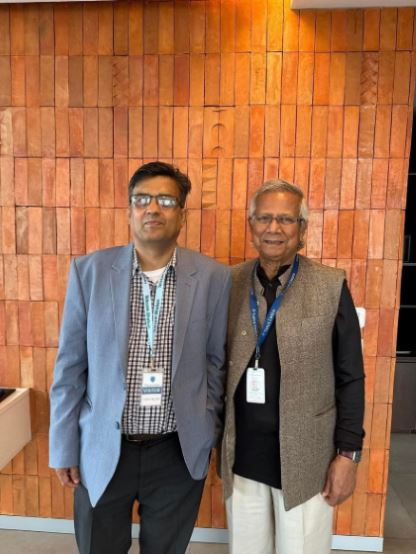
Shafiqul Alam (left) with Professor Muhammad Yunus. Photo courtesy: Shafiqul Alam
Alam: Professor Yunus arrived in Bangladesh on August 8 and was sworn in on the same day. And I got the offer on the night of next day. And we started the work on the morning of August 10. So, we immediately had to jump into work. The New York Times, AFP, and BBC—they all came. A large team of journalists, about six or seven people, came to interview Professor Yunus soon after he was sworn in. And I felt like I was thrown right into the middle of it. SDGs affairs coordinator Lamiya Apa [Lamiya Morshed was the principal coordinator for SDGs affairs at the Chief Adviser’s Office] introduced me to Professor Yunus, who said, “Okay, start work right away.”
Apart from that, not much else happened, but I saw that he was extremely busy with a huge amount of work, and the interview happened right in the middle of it. I helped manage the journalists who were asking questions to ensure the interview went smoothly.
Question: Was there a moment when you suddenly realised, “I am witnessing history, and one day people will want to hear these stories”? What was happening at that moment?
Alam: I think this is a historic event. In Bangladesh, after ’71, this is the first time such a big revolution happened. A horrific fascist government and dictatorship was forced to flee and ousted from power. And those who made this revolution—their thoughts, the fruit of the revolution was the interim government.
I felt I was a part of the revolution. We tried to turn the thoughts the revolutionaries had into reality. The thought was imbued with the idea of bringing good governance to the country. If you look at the graffiti at that time, everything spoke about reform. Professor Yunus’s focus was on how many kinds of reforms could be made so that the people of the country get good governance, so that people’s rights are not curtailed, so that people don’t face discrimination, and so that inequality comes down.
The interim government was working towards post-revolution peace and stability — ensuring that the activists of the Awami League who committed atrocities for more than 15 years do not face revenge attacks, and restoring justice and accountability because those who committed enforced disappearances, extrajudicial killings, bank robberies, and looted people’s money must face trial.
And finally, holding an election that was so pristine and flawless that no one can utter a single word against it — an election also conducted by Professor Yunus. So every single day, you felt like you were part of history.
Question: What did you discover about Professor Yunus that you could never have learned from reading his books, watching his speeches, or following his public career?
Alam: That’s a very good question. He is an extremely organized person, deeply committed to his work, and fiercely patriotic. His thoughts are constantly focused on how the country and its people can prosper, how to uplift human dignity.
He is deeply dedicated and doesn’t waste a single minute. Even when he was sick day after day, he still worked. No one could say, “He is sick today, so work is canceled”— no, he kept holding meetings.
And he listened passionately to anyone who led movements or protests. His understanding of Bangladesh’s history, culture, and people is very deep. He could have lived abroad, but he didn’t — his dedication to the country is absolute. He is a saintly figure; I saw no greed, jealousy, or hatred in him. He is a hardworking person whose entire focus is on how to help people, speaking about three zeroes [zero poverty, zero unemployment and zero net carbon emission], social business, and spreading microcredit to empower the poor. But when he joined the interim government, his prime focus was the country’s welfare and ensuring liberty, freedom of the press, freedom of expression, and freedom of association. Bangladesh saw a golden era during his tenure.
Question: Nobel laureates are often portrayed as extraordinary intellectuals. But what is Professor Yunus like during an ordinary, uneventful day? How does he speak, interact with colleagues, and spend the moments between official engagements?
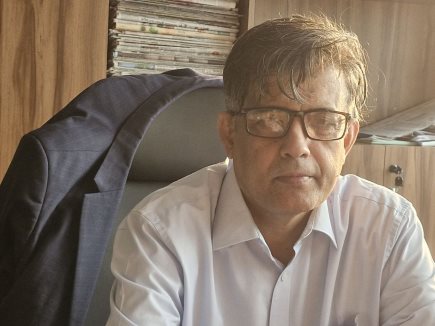
Shafiqul Alam is the former press secretary to Professor Muhammad Yunus, currently serving as the editor of Daily Waadaa. Photo credit: Kayes Sohel
Alam: He speaks to all. He is like any other man. He is a good listener. His first and foremost attention was on the work. Another thing is that he never wastes time unnecessarily. When needed, he works up to midnight.
Question: What makes Professor Yunus laugh? Can you recall a funny or unexpected incident when his sense of humor emerged in the middle of an otherwise serious deal?
Alam: Well, his laughter usually came through casual stories or old memories. But he didn’t waste time on idle chatter. His life’s goal was helping people, pulling them out of poverty, creating job opportunities, and fighting the terrifying impact of climate change. He was serious about creating jobs and social business.
If someone happened to crack a joke or a funny incident came up contextually, he would laugh and enjoy it wholeheartedly. But he never wasted time on useless banter.
Question: How does Professor Yunus react when something goes wrong? Does he become visibly frustrated, grow quiet, ask questions, or immediately start looking for solutions? Can you share your experience?
Alam: Honestly, whenever things got chaotic or something went wrong — and trust me — he never lost his temper. He wasn’t the type to throw tantrums. Instead, he just stayed totally calm and looked right for a practical solution. Because he’s so disciplined and deeply organized, he’d listen carefully, figure out what needed to be fixed, and immediately dive back into work without wasting a single second. Working through those crazy, high-pressure moments with him showed me just how saintly and resilient he really is.
Question: When Professor Yunus spoke with foreign leaders, what tended to interest him most: economic cooperation, social business, climate change, poverty reduction, young people, or something else?
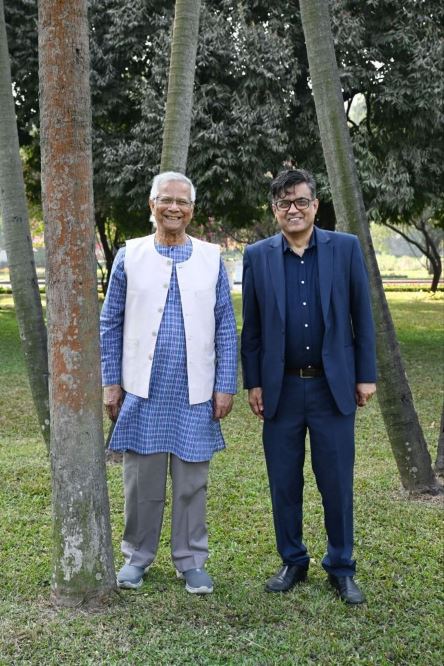
Professor Yunus and Shafiqul Alam (right). Photo courtesy: Shafiqul Alam
Alam: When he represented Bangladesh, his core interest was always Bangladesh—how Bangladesh could prosper, create jobs, and develop. So, economic cooperation, diplomatic cooperation, and any cooperation that benefited Bangladesh were his top priorities.
When he spoke with foreigners, he spoke with such deep familiarity of their countries and cultures that it felt like he had lived there for years. Because of this, talking to them was never difficult, and he had many friends worldwide. But his main focus remained the interests of Bangladesh, increasing exports, bringing investments, and securing diplomatic cooperation.
Question: Did Professor Yunus ever explain what success means to him personally? Is it measured by awards and recognition, by institutions built, or by the lives of people who benefit from his work?
Alam: No, to him, success meant how much benefit his work brought to people’s lives. Those who benefited from his social businesses, the jobs created, the poverty alleviated—that was his true measure of success. What mattered most for him was standing by people, lifting them out of poverty, and advancing the ‘three-zero’ world.
Question: Is there a particular memory of Professor Yunus that makes you smile whenever you think about it?
Alam: Every single moment with him was good. He was a genuinely good person, and I feel honoured to have worked with him.
Question: Imagine that a young Bangladeshi reads this interview thirty years from now. What one story about Professor Yunus would you want that young person to remember — and what would you want them to learn from it?
Alam: Not just one story — his entire 18-month tenure is like a fairy tale. But what stands out most is his deep, genuine empathy for the people of July [the uprising], for the victims of injustice, and his unwavering love for the country. Every single incident during that time was significant and important.
*Short note on Prof. Yunus: Few people have changed the way the world thinks about poverty quite like Professor Muhammad Yunus. A visionary Bangladeshi economist, social entrepreneur, and Nobel Peace Prize laureate, he challenged conventional banking by demonstrating that even the poorest people deserve access to credit and the opportunity to shape their own futures. Through his pioneering work with microcredit and the establishment of Grameen Bank, he inspired a global movement for social and economic change. In 2006, he was awarded the Nobel Peace Prize for his efforts to create economic and social development from below. Nearly two decades later, in August 2024, he stepped into an entirely different role as Chief Adviser of Bangladesh’s Interim Government, taking on the formidable task of guiding his country through a historic political transition.
*The interview is conducted by Dhaka based freelance journalist Kayes Sohel.
SDG – Sustainable Development Goal