
At one time, generative AI was thought of mostly as a research project; however, it is quickly becoming one of the major components of digital infrastructure and is no longer considered only a niche capability related to chatbots or image generation. Through 2026, continued investment will allow generative AI to be used to help change how organizations develop systems, make decisions, and innovate; therefore, generative AI is far from simply a new tool.
Generative AI Market : DataIntelo (please click image to enlarge)
As this shift unfolds, advances in machine learning infrastructure and predictive modeling are providing an environment where businesses will be able to think about technology differently.
According to DataIntelo, the global generative AI market was valued at $62.4 billion in 2025 and is projected to reach $978.6 billion by 2034, advancing at a robust compound annual growth rate (CAGR) of 35.8% during the forecast period from 2026 to 2034, making it one of the fastest-expanding technology markets ever documented.
The Expanding Role of Generative AI
(A) what it generates and
(B) Ways in which organizations are incorporating Generative AI into workflows. Currently, organizations use Generative AI to embed generative AI technology into:
- Product Development Cycles
- Customer Interaction Systems
- Data Analysis Pipelines
- Content & Knowledge Management
This transition marks a move from reactive systems to proactive, intelligence-driven environments.
Market Momentum and Growth Outlook
The Global Generative AI ecosystem is growing fast, due to businesses adopting the technology and investing more heavily in new AI infrastructure.
Key growth factors include:
- Automation of knowledge-based work
- Larger datasets now available
- Advances in both cloud computing and NVIDIA GPU processing power
- Increasing demand for real-time decision-making solutions
By 2033, the market is projected to evolve into a multi-layered ecosystem where Generative AI is deeply embedded across industries such as healthcare, finance, manufacturing, and digital services.
Infrastructure: The Backbone of AI Innovation
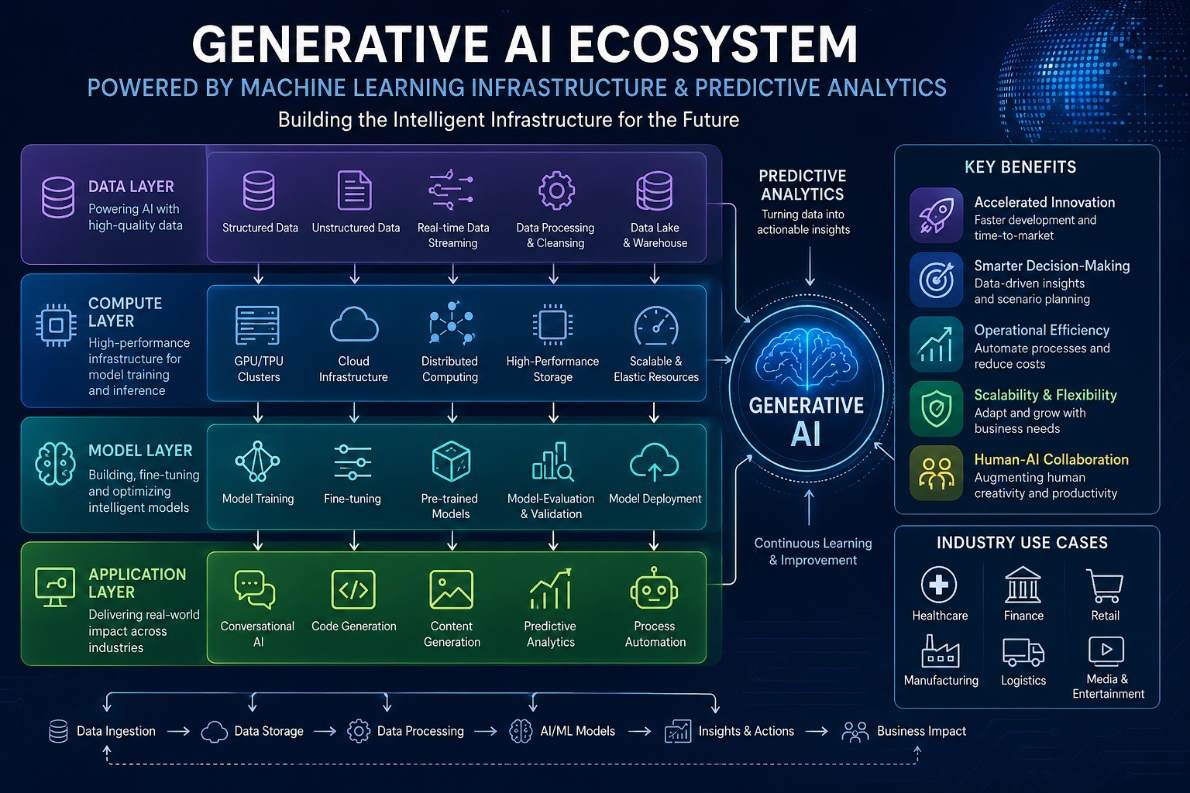
To support each generative AI system, there is complex infrastructures built on four layers:
- Data Layer – Provides high-quality structured and unstructured data to train AI models on. There are now data pipelines set up that ingest, clean up and “refine” data in real time.
- Computing Layer – Requires very large amounts of computational power. The growth of distributed computing has allowed us to utilize GPUs and special AI chips so that we can train and deploy large models more easily.
- Model Layer – Contains all of the machine learning models that we train, fine-tune, and optimize. Many organizations are using hybrid approaches, wherein they use a pretrained model and make domain-specific customizations.
- Application Layer – The end-user layer where customers are able to use applications based on predefined AI capabilities. (eg. Conversational interfaces, predictive analytics dashboards).
This layered architecture supports scalability, flexibility, and performance, which are among the most important characteristics of any modern AI system.
The Intersection with Predictive Analytics
Generative AI is not an alternative to predictive analytics, but a major improvement to it. Predictive analytics were previously based on past data to provide forecasts of likely outcomes and allow companies to anticipate trends and make data driven decisions that are informed. Generative AI takes predictive analytics a step further by simulating many possible future scenarios, creating alternative strategies for pre-planned actions, and generating synthetic datasets to test hypotheses and provide benchmarks. With this depth of analysis, businesses can now explore the ‘what could happen’ and how to respond instead of simply asking the question of ‘what will happen’ regarding a trend in the market. Therefore, as a result of being able to answer both questions, businesses can make much more dynamic, strategic, and resilient decisions when faced with uncertainty.
Engineering Challenges and Considerations
While generative AI can revolutionize an organization, there are huge engineering and operational challenges in deploying generative AI at scale as noted below. Ensuring that the generative AI model performs reliably (i.e., providing accurate, consistent, and contextually relevant) for any use case is one of the main challenges faced. Another common challenge faced by organizations is data governance, as organizations need to manage data privacy, security, and regulatory compliance for data used in a more complex digital environment (e.g., cloud computing). Lastly, infrastructure cost is another important factor in deploying generative AI, so organizations need to balance the cost of a high-performance computing environment with the cost of running the generative AI effectively. Furthermore, the integration of generative AI with existing workflows and legacy systems may slow down the pace of adoption due to a lack of alignment between generative AI systems and existing workflows and legacy systems. Additionally, the solutions to these major challenges will require organizations to not only have advanced technical expertise, but also to have a clearly defined strategic roadmap that aligns with the organization’s business objectives and considers future technological developments (e.g., artificial intelligence).
Emerging Trends Shaping the Future
There are many different ways that Generative AI is becoming more mature over time. Many of these trends are starting to become evident in the next phase of Generative AI. One trend that is taking hold is the creation of AI-native applications – applications that were designed from the beginning to include AI as a core part, rather than adding it afterwards. AI-native applications will fundamentally change how software is built and used.
A second trend that is emerging is the movement towards real-time intelligence. Many of today’s AI architectures are capable of processing information and producing intelligent output in real time, thereby enabling businesses to make more informed decisions faster. This ability to make rapid decisions is especially important in industries where timing is critical, such as finance, healthcare, and supply chain management.
Third, business leaders are investing in additional models that are specific to their industry and/or a specific use case. These new models are producing superior output because they incorporate data and context that are specific to that industry.
Fourth, collaboration between humans and AI is becoming increasingly important. Instead of replacing people, Generative AI is being used to enhance humans’ skills and capabilities by facilitating creativity, increasing productivity, and providing more innovative solutions to many different types of problems.
A Shift Toward Intelligent Ecosystems
We’re not looking at the development of any one kind of technology; instead, we’ve seen the development of an entire intelligent ecosystem. By taking advantage of generative AI as well as machine learning infrastructure and predictive analytics, organizations can accelerate their operations through faster, smarter, and more adaptable methods. Using these methods together gives organizations a better way to combine data, systems, and ways of making decisions—ways in which they weren’t able to do before now.
This means that the conversation has gone from whether organizations should include AI into their operations, to how can organizations effectively introduce and implement AI into their primary business processes. Organizations that can effectively integrate AI into their operations will be able to develop new products and services, compete with others, and respond to the very fast changes taking place in today’s marketplace.
Conclusion
From an innovation standpoint, generative AIs are moving towards being part of the general fabric of today’s digital infrastructure. Their core value is in their ability to bring together data, computing power and decision making as a more coherent and intelligent entity.
As industries continue to evolve; organizations that create scalable AI infrastructures and align these investments with their long-term strategy will be better positioned to adapt to the complexities of tomorrow’s world. The next 10 years will not just see AI influencing the way we do business; they will see it influencing the very foundation of the global economy.
Access Full Report: https://dataintelo.com/report/generative-ai-market